
I learned much about Old Spice shaving mugs from various postings on the Razor Emporium website, including episode 8 of season 1 of I’d Rather Be Shaving, “Old Spice Collectibles with Douglas Smythe and Matt Pisarcik,” which includes “Old Spice Mugs–Dating & Variations.” Also the YouTube video The Gentleman’s Club with Marc Antomattei, featuring “1st Old Spice Shaving Mug Ship Grand Turk by Hull Pottery (1938-41).”
I use two different, fairly common Old Spice shaving mugs, with two different brands of shaving soaps. I started reading up on Old Spice and I learned that its shaving mugs first appeared in 1938, introduced by William Lightfoot Schultz’s Shulton Company shortly after the debut of the Early American Old Spice line for men. The first shaving mugs were handcrafted of ceramic and pottery by the A.E. Hull Pottery Company in Crooksville, Ohio. These early mugs typically featured the “Ship Grand Turk” sailing design, celebrating the spice-trading heritage of Salem, Massachusetts.
The Shulton Company was a toiletries and cosmetics manufacturer founded in 1934 in New York City. As demand outgrew the space, officials leased larger facilities at the Lipton Tea building in Hoboken, New Jersey. In 1946, Shulton opened a massive 42-acre corporate headquarters and factory complex located in Clifton, New Jersey. It was vacated and demolished in the early 2000s and eventually converted into a residential townhome complex. The Shulton Company manufactured the brand for decades until Procter & Gamble bought the Old Spice brand from American Cyanamid, which had previously acquired the Shulton Company. Procter & Gamble took over worldwide Shulton operations in 1993.
Material: Pottery vs. Milk Glass
The composition of the Old Spice mug instantly narrows down the decade.
- Thick Ceramic / Pottery (1938–1948). The earliest mugs were made of pottery and ceramic and often included handcrafted characteristics and slight factory imperfections. They were produced by various companies, most notably Hull Pottery from 1938–1941.
- White Milk Glass (1948–1992): In 1948, Shulton transitioned to machine-made glass mugs manufactured primarily by the T.C. Wheaton Glass Company of Millville, New Jersey. These have a smooth, translucent quality and usually a small mold number stamped into the glass on the bottom. This number identifies the factory machine mold used to cast that specific piece of glass. Thus, if a defect or crack was found on the assembly line, inspectors could use that number to trace the flaw back to the exact faulty machine mold.
The Interior Bottom of Milk-Glass Mugs (Rib Count)
If you have a milk glass mug, look inside at the bottom where the shaving soap cake rests. The internal ridges or “ribs” were added over time to prevent the soap puck from spinning while lathering.
- No Ribs (1948–1949): The first-ever glass mug variation is completely flat and smooth on the inside bottom.
- 3 Ribs (Late 1949): A very rare transition model that features just three raised ridges. It was only manufactured for a few months.
- 6 Ribs (1950–1992): The most common style. Virtually all standard glass soap mugs made from 1950 onward feature six distinct interior ribs.
Ship Graphic and Text Styling
The specific historical clipper ship and the type font printed on the mug reveal the precise sub-era.
- Ship Grand Turk (1938–1941 / 1960s): Appears on the earliest pottery mugs, but a refreshed version featuring “Ship Grand Turk Salem 1786” also returned on glass mugs throughout the 1960s and 1970s.
- Ship Friendship (1941–1950s): Introduced during World War II on later pottery mugs and carried over into the earliest glass mugs.
- Bold Cursive / Script Logo (Mid-Century): Mugs from the 1950s and 1960s feature the words “Old Spice” written in a sharp, bold, red cursive font.
- Decal or Printed Logo (Late 1970s–1992): Later Shulton models feature less pronounced, flat-printed graphics and sometimes cleaner block lettering.
Post-Shulton Identification (1990+).
If your mug features a generic sailboat rather than an authentic, detailed colonial clipper ship, it was made after Procter & Gamble bought the brand. Procter & Gamble officially retired the classic glass shaving mugs in the early 1990s.
A Gallery of Old Spice Mugs
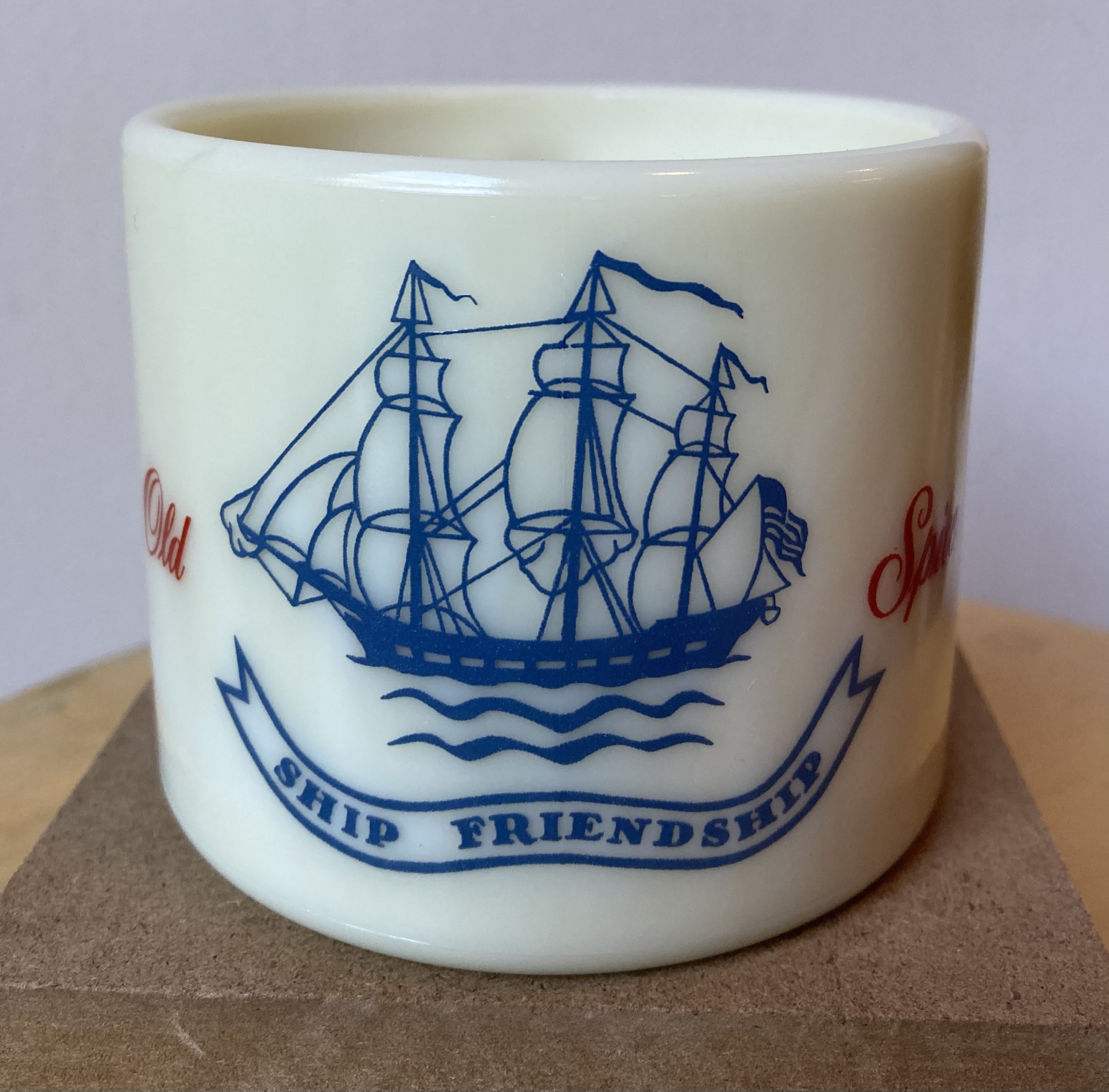
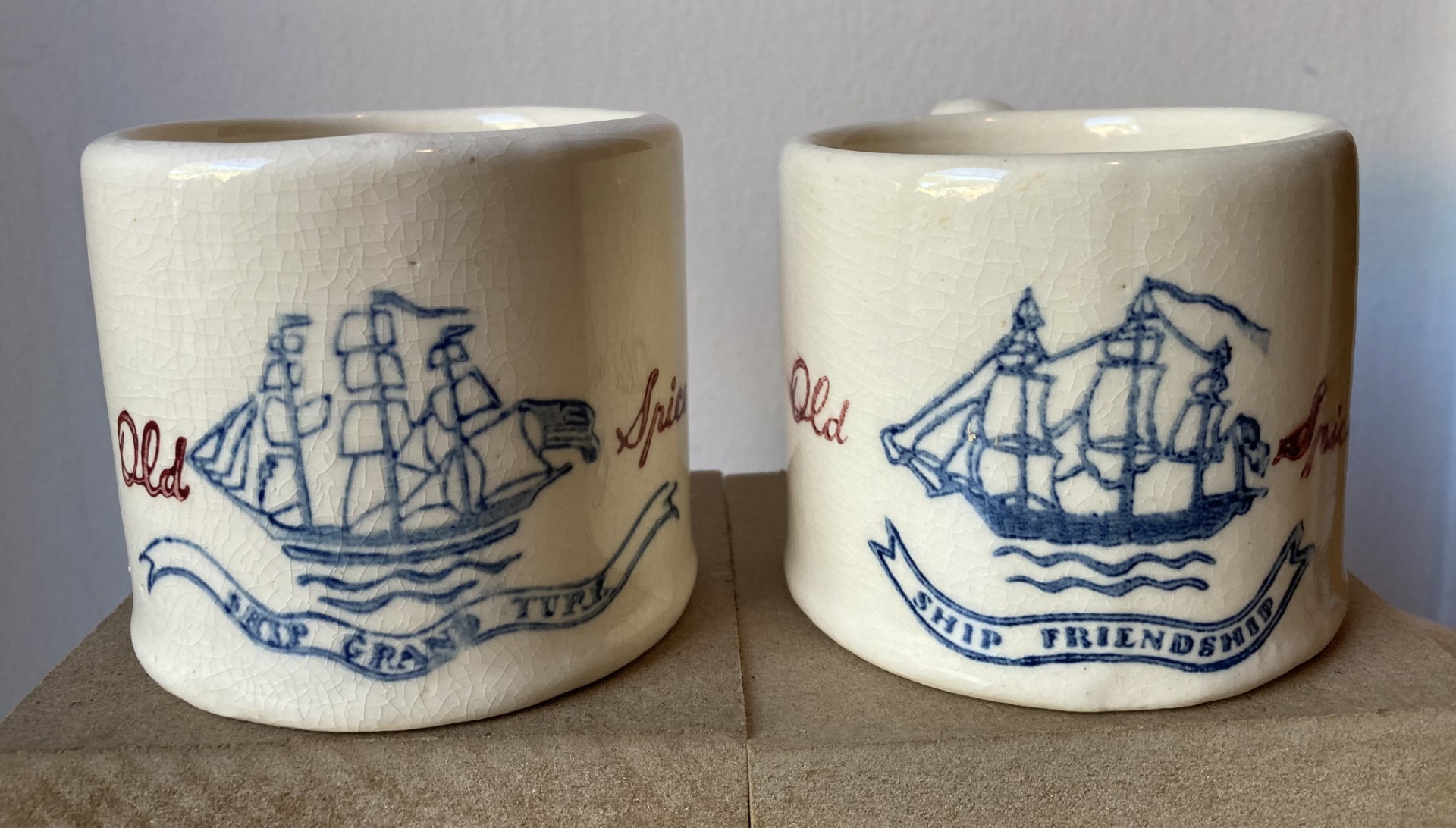 (Photo, left): Shown here is the first Old Spice shaving mug, a pottery mug manufactured for Shulton Company by the A. E. Hull Pottery Company of Crooksville, Ohio, from 1938 to 1941. It features “SHIP GRAND TURK” in a blue banner below a blue sailing ship, with “Old” and “Spice” in bright red letters on each side. On the bottom is blind-stamped “Early American” / “Old Spice” / “Shaving Soap” / “USA” / “Shulton.” (Photo, right): Beginning in 1941, the A. E. Hull Company manufactured a similar pottery shaving mug featuring the “SHIP FRIENDSHIP.” (Click on image to enlarge.)
Since these two mugs are handmade pottery, not the milk glass that was characteristic of later Old Spice mugs, they have slight imperfections, such as smeared and blurred lettering (note the smeared “ND” of “GRAND” and “K” in “Turk” in the left mug and the smeared “S” of “Spice” in the right one). The mugs measure 3.0” in height and 4.5” from rim to handle. (Many of the later milk glass Old Spice mugs are 2.75” tall or smaller.)
I also have (not shown) a pottery “SHIP FRIENDSHIP” shaving mug that is 2.75” tall. On the bottom is blind-stamped: “Early American” / “Old Spice” / “Made in USA.”
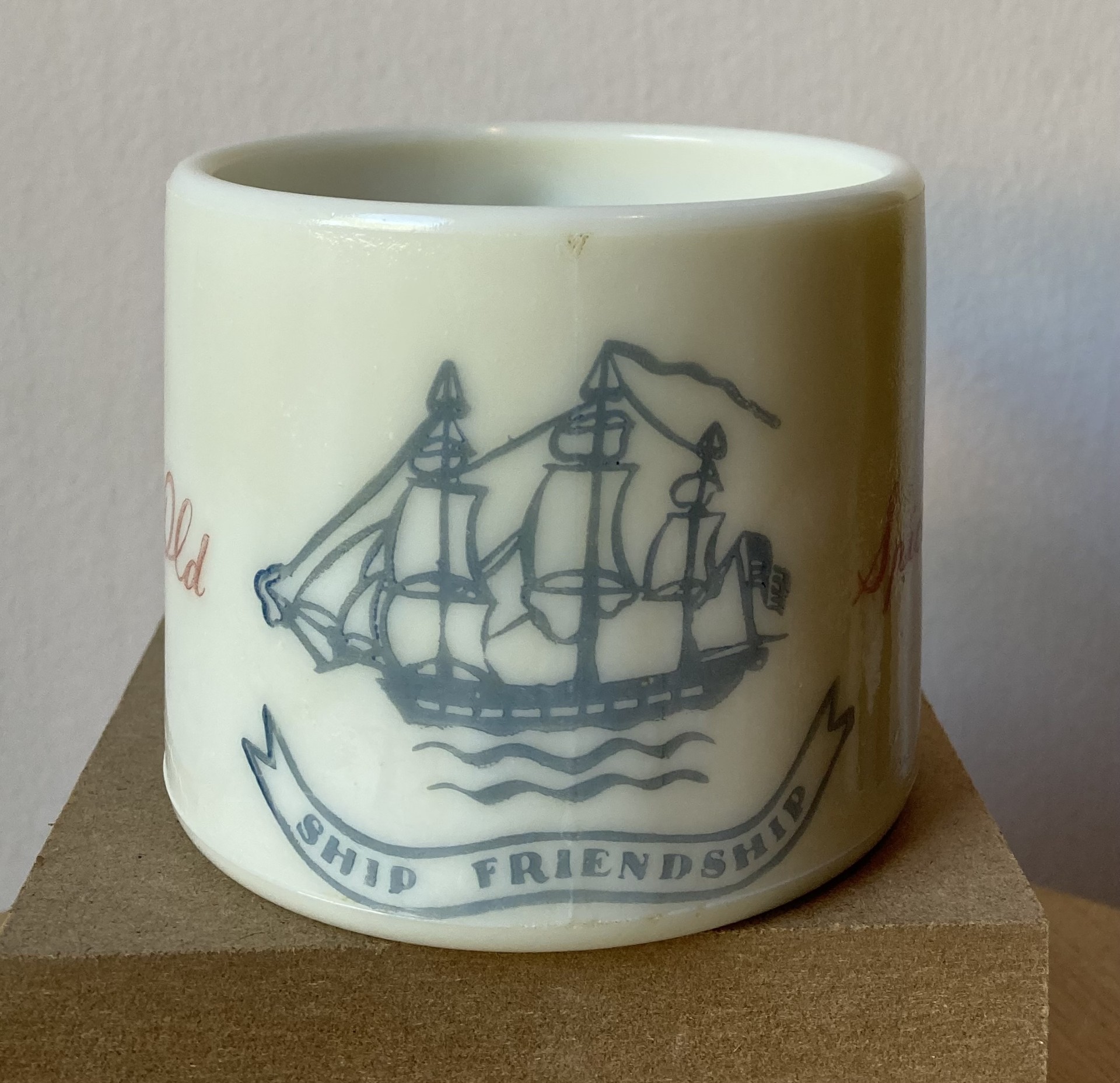 In 1948, Shulton introduced its first glass mug, which was manufactured by T. C. Wheaton Company of Millville, New Jersey. This marked Shulton’s transition into glass production after moving away from the fragile, primitive Hull pottery mugs used from 1938 to 1948. It is the only glass Old Spice mug that does not have any vertical “ribs” around the interior sides to keep the soap puck in place during the lathering process. On the bottom it reads, “Early American Old Spice / Shulton, Inc. / Clifton, N.J.” These were made from 1948 to 1949.
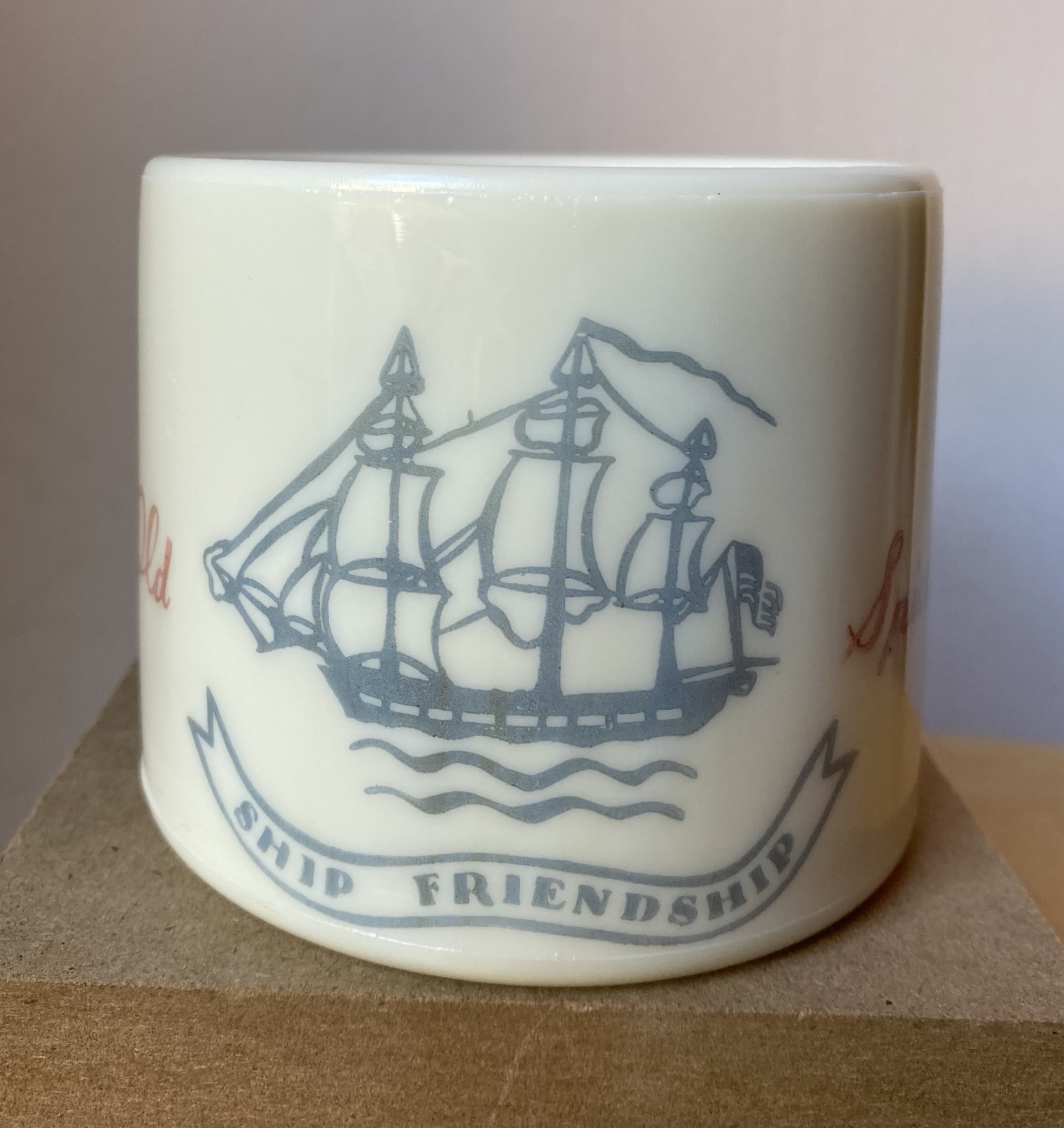
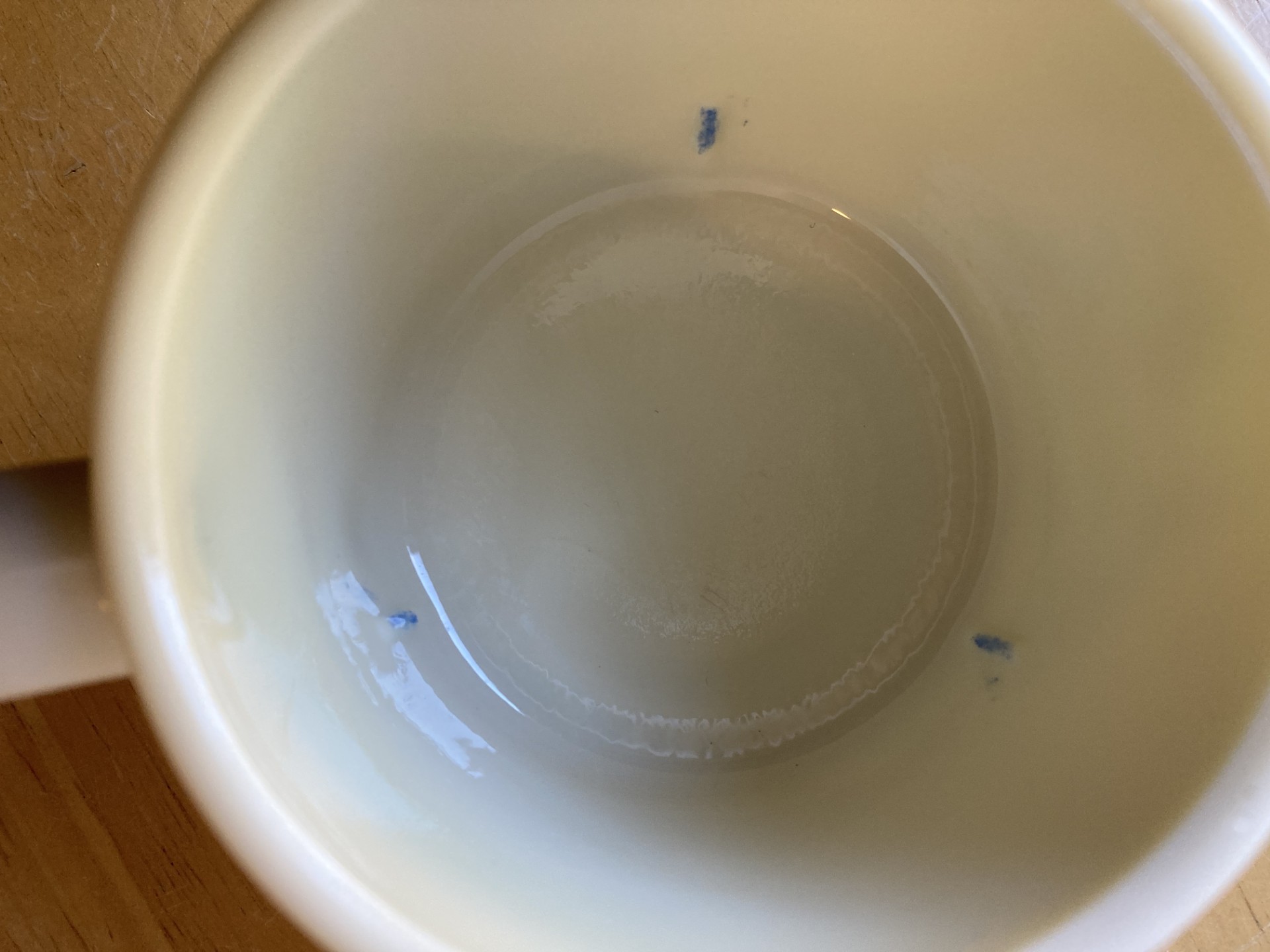 This shaving mug (left and right) with the “Ship Friendship” is identical to Shulton’s first milk-glass mug, except for its three interior ribs (which for this photograph I marked faintly in blue). These shaving mugs were produced for a few months in late 1949 before being replaced by the six-rib design, which can be found on all the Old Spice soap mugs from 1950 through 1992. It is 2.75” tall and 4.5″ from rim to handle. (Click on images to enlarge.)
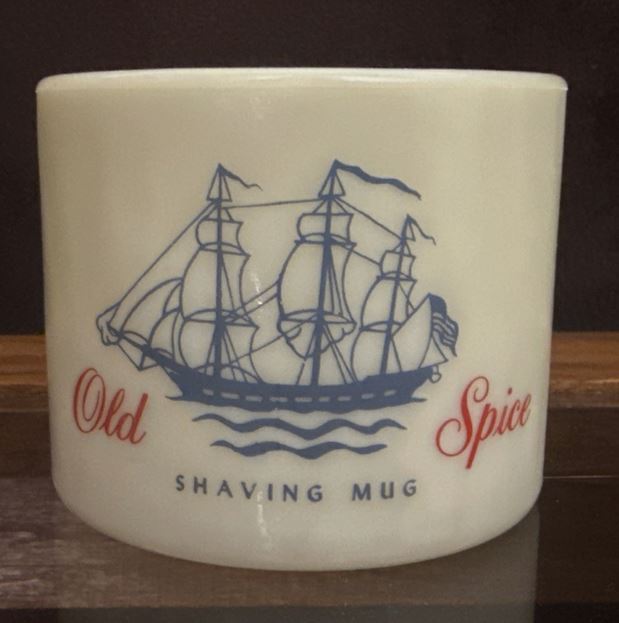
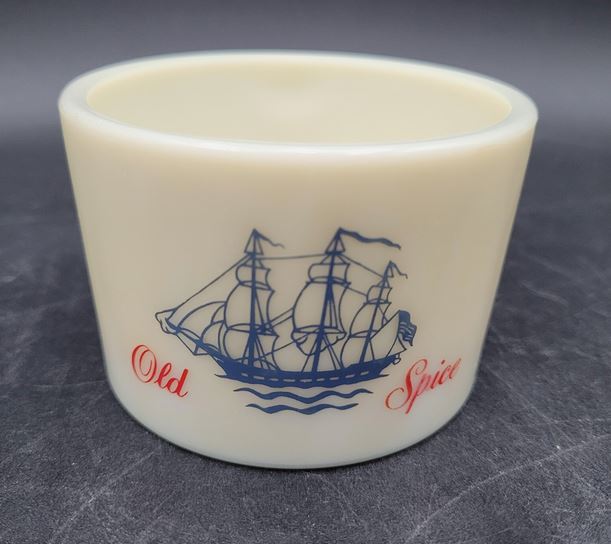 These glass mugs have the ship in the front of the mug, opposite the handle. The one at left has the words “SHAVING MUG” on it. The mug at right was produced between 1961 and 1964 and represents the last of the Old Spice mugs without the lips around the rims.
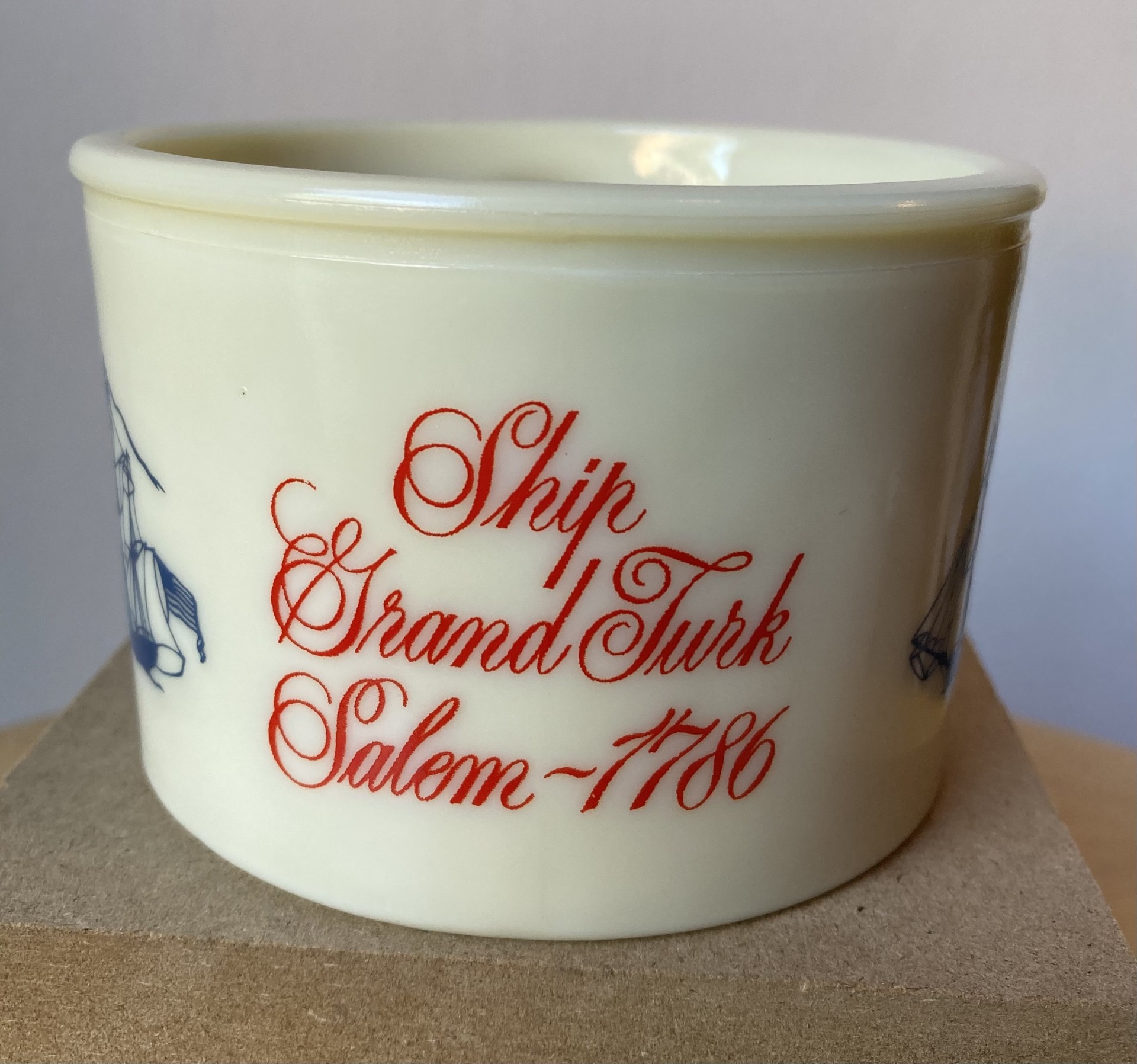
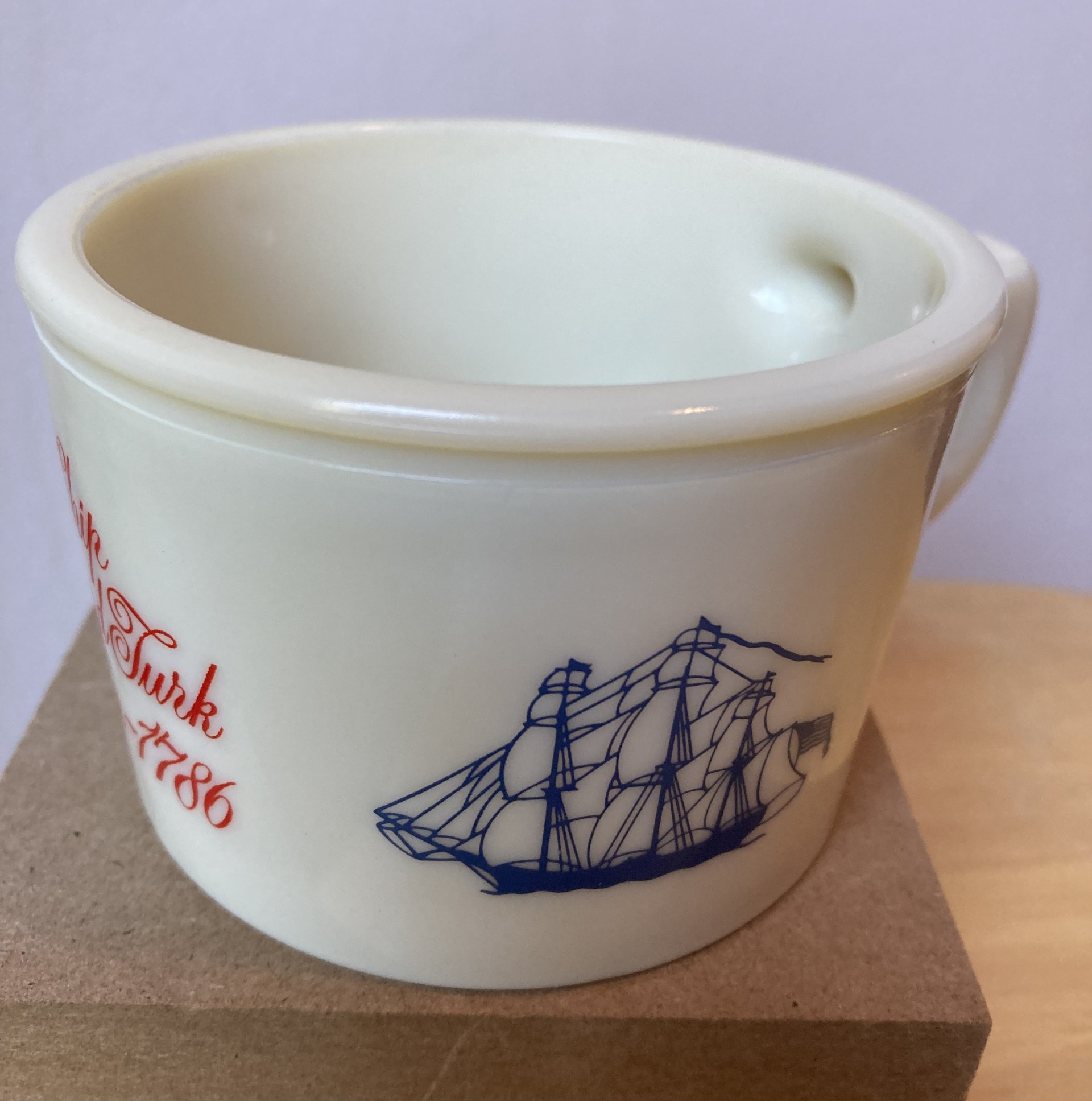 This mug was produced beginning in 1964 and highlights the “Ship Grand Turk Salem – 1786.” The text is at the front of the mug, opposite the handle, and is complemented by the ship’s image on either side. According to the website Old Spice Mugs—Dating & Variations, “The Late Glass mugs differ from the Early Glass mugs in that they have a lip around the rim” (shown here). The mug is 2.25″ tall and 4.5″ from the rim to the handle. (Click on images to enlarge.)
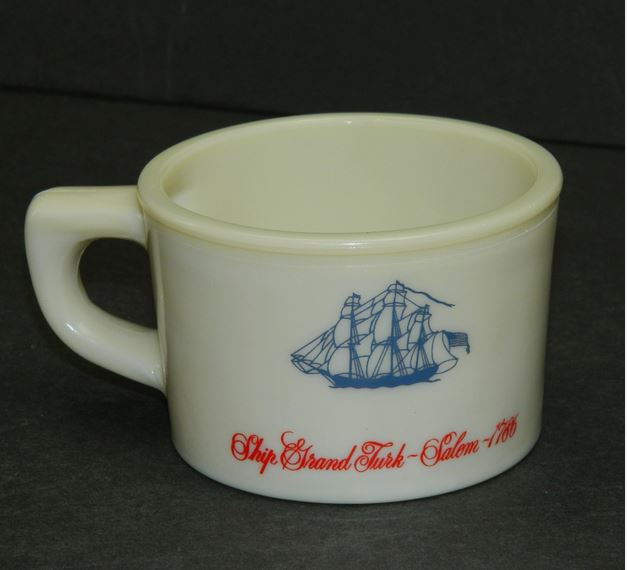
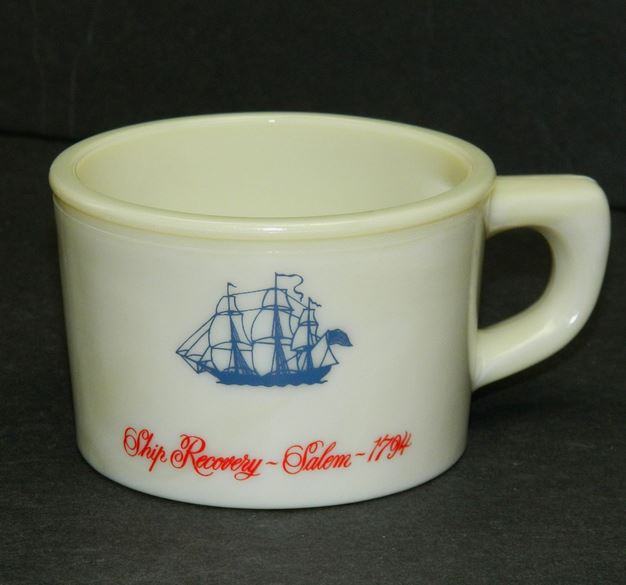 From the website Old Spice Mugs—Dating & Variations, this “is the only Old Spice mug to feature two ships, the “Ship Grand Turk – Salem – 1786” and the “Ship Recovery – Salem – 1794. . . . It was manufactured starting in 1978.” (Click on images to enlarge.)
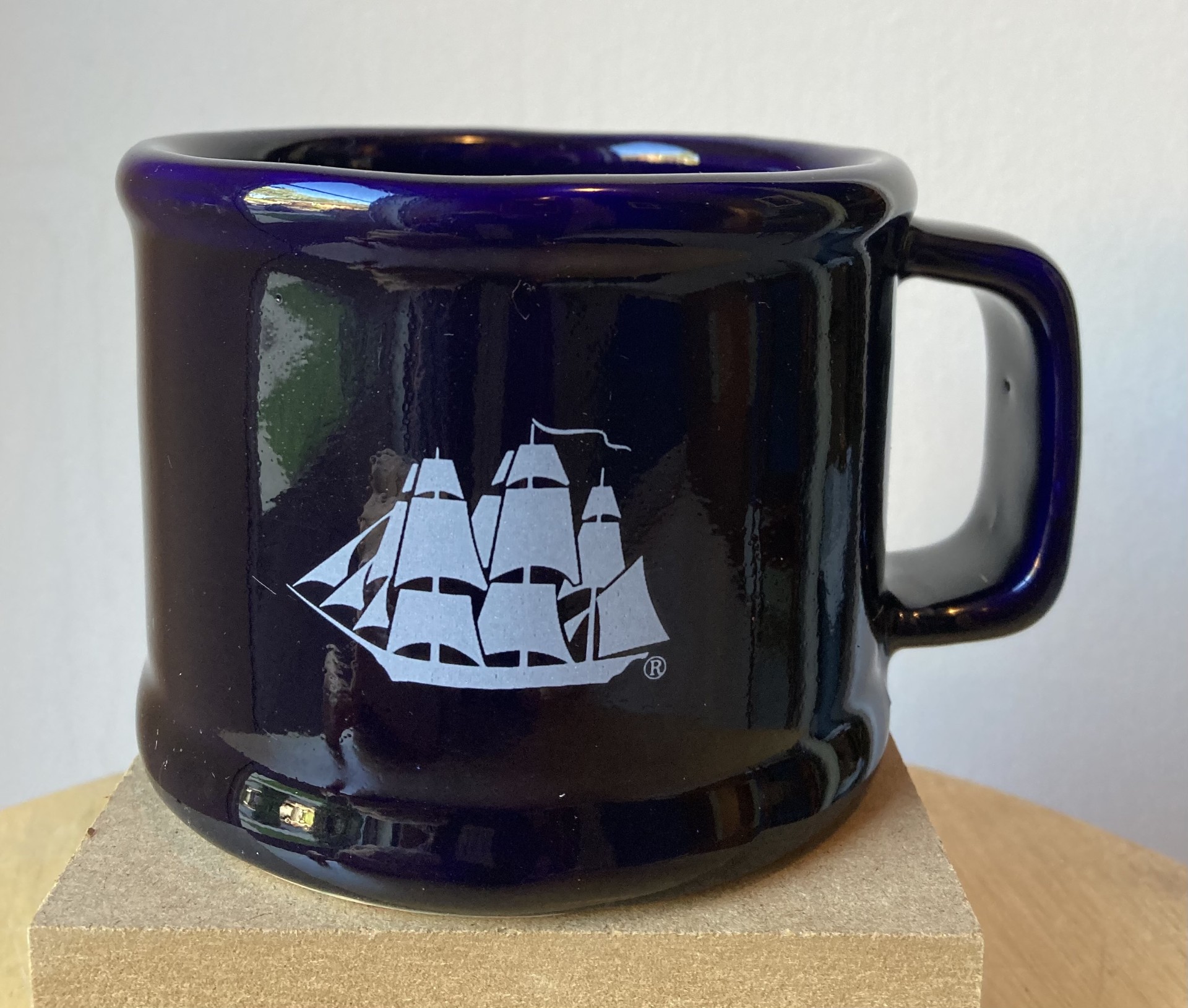
 (Left): This heavy blue shaving mug, with no ribs, was copyrighted by the Shulton firm in 1985. It is 3″ tall and 4.75″ from rim to handle. (Right): This mug was made in 1984 and 1985 as a coffee mug. It is 4″ tall and 5″ from rim to handle. (Click on images to enlarge.)
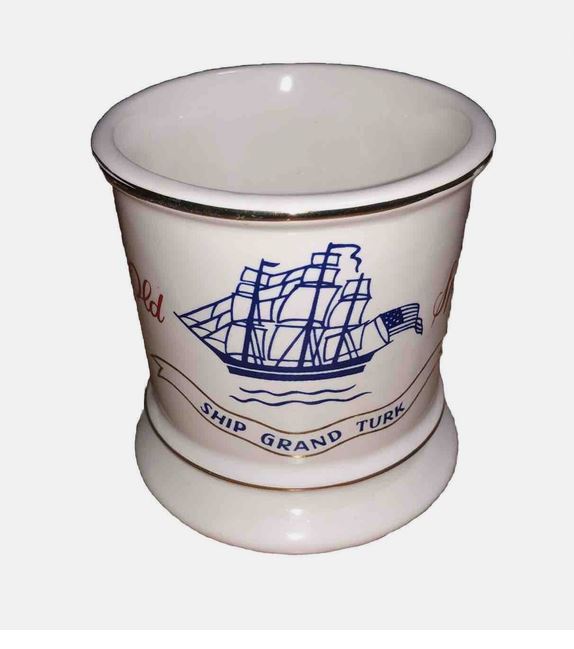 In 1970, the McCoy Pottery Company was commissioned to make limited edition Old Spice “Grand Turk” shaving / coffee mugs for officials and employees. The McCoy version is more ornate, taller, and heavier than the standard Old Spice mugs, and it is made of distinct ceramic stoneware rather than the classic milk glass. The customary red “Old” and “Spice” words appear off to each side. (Click on image to enlarge.)
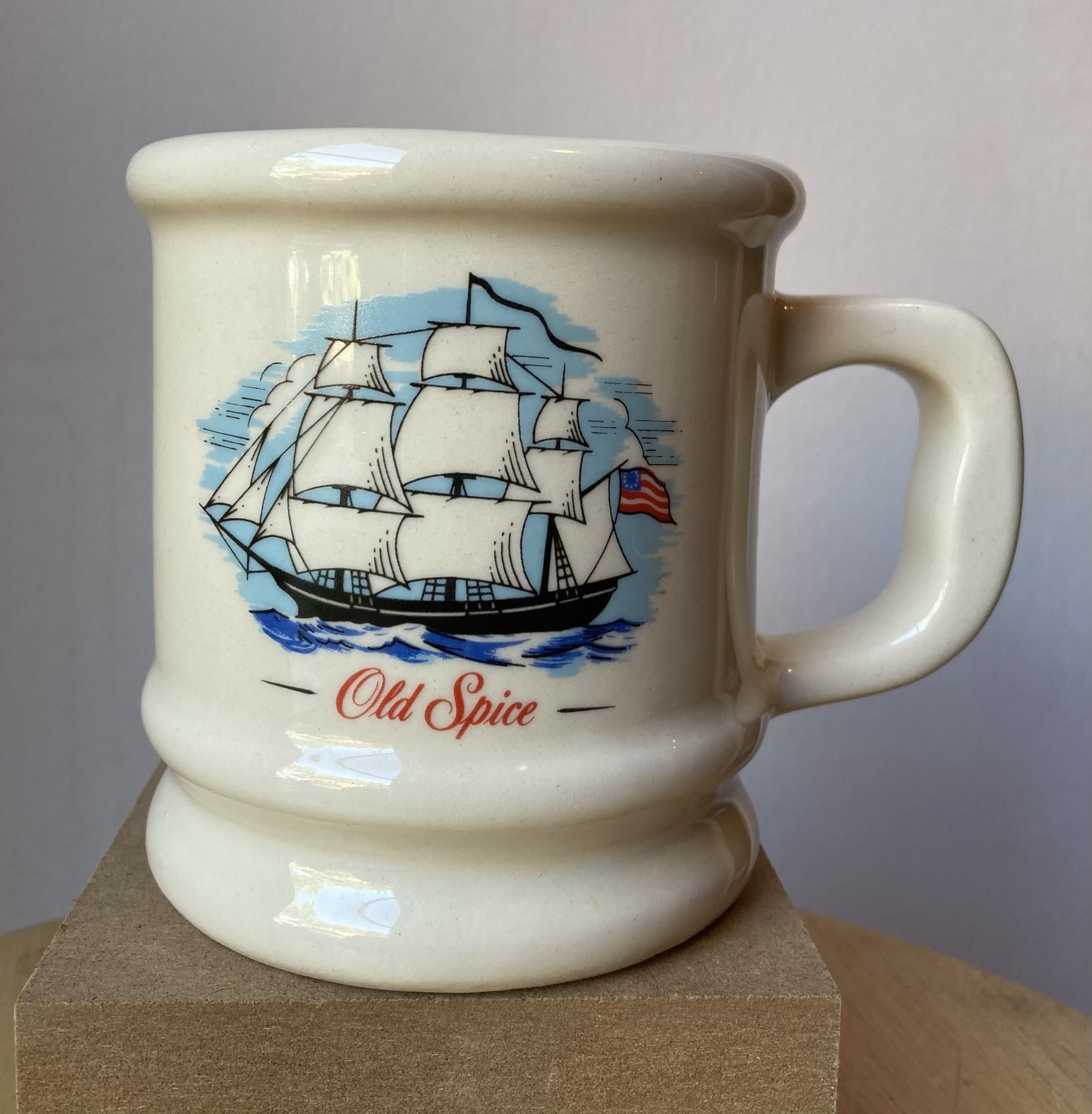
 As for me, I use both the blue ceramic shaving mug (above) and this glass one, with its distinct, bold lines and sharp appearance. It takes a 3″ shaving puck, though you might need a grater to trim it slightly. The blue mug has a 3.5″ opening, but you can melt a shaving puck or two, which is what I do. In terms of shaving soap pucks, I like Artifact Soapworks, Colonel Conk, Van Der Hagen, and The Village Soapsmith. (Click on image to enlarge.)