
Keith Estep explains in his The Shaving Mug and Barber Bottle Book (1995) that to boost mug sales, an innovative idea emerged: personalizing each mug with an individual’s name elegantly printed in gold script. These exquisite mugs, crafted from high-quality china, were imported from Europe. The personalization process took place at the barber’s supply distributor, adding a special connection to the community. For each mug a customer ordered, the barber would earn a commission, creating a win-win situation for everyone involved.
Taking this a step further, Estep believes that it was likely the barber who recognized the value of a mug featuring both a name and a trade design, which created a way for customers to connect with their professions. By the 1880s, leading barber shop distributors had established decorating departments dedicated to crafting these trade design mugs. Alongside these, they also produced elegant floral patterns and mugs showcasing fraternal emblems.
In “Shaving Mugs: Objets d’Art from the Barbershop,” a fine pictorial essay in The Encyclopedia of Collectibles (Time-Life Books, 1980), author–and mug collector–Burt Handelsman notes that the largest firm was the Koken Barber Supply Company, based in St. Louis, where they crafted up to 90 hand-painted mugs each day. Other companies whose names collectors might find on the bottoms of their mugs include Smith Brothers in Boston; the Theo A. Kochs Company out of Chicago; B. Stuebner’s Sons in Brooklyn; the Lewis Stenger Company of Portland, Oregon; E. Berninghaus in Cincinnati; Hecker Brothers of Kansas City, Missouri; and the Hytes Company in Topeka, Kansas.
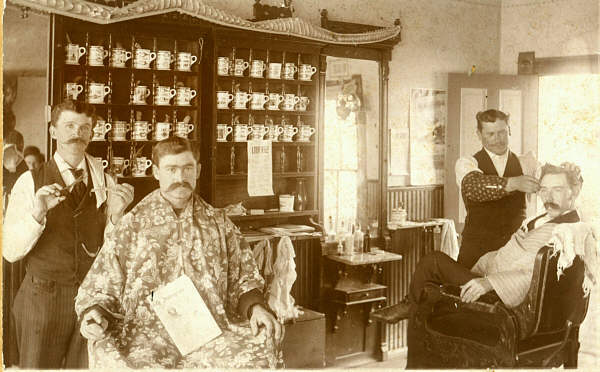 Patrons walking into a barbershop during the latter part of the nineteenth century would immediately notice the impressive display of personalized shaving mugs lining the walls, usually in specially made display cases. The more mugs, the greater the shop’s popularity among its patrons. On his first visit to a barbershop, a gentleman was invited to browse through catalogs with various options to create his very own personal mug. (This photograph of a barber shop in Olean, Missouri, circa 1897, is from “Barber Shops,” Miller County Museum and Historical Society, Tuscumbia, Missoui. Click on image to enlarge.)
I am not a serious collector, but I like attractive, brightly colored mugs lined up on top of my bookshelves. If a mug has a person’s name on it, I am particularly interested in discovering information about the owner. I discuss my research below, though I readily admit that in some cases I can only make educated guesses as to the identity of a mug’s owner.
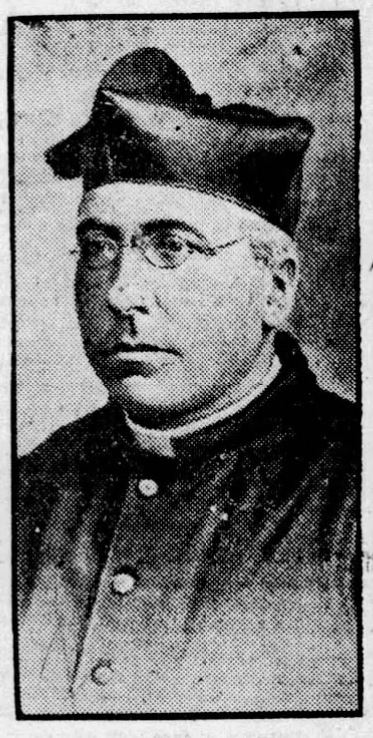 But I think I am on target with this one. The mug below belonged to Reverend Blasius Winterhalter, born in 1833 in the village of St. Peters, located in the Grand Duchy of Baden, Germany. He immigrated to the United States in 1854 and was ordained as a priest a decade later, in 1864. His inaugural assignment took him to a church in Springfield, Illinois, where he served for one year. He then spent six years in Columbia, Illinois, and for 37 years he was the beloved pastor of St. Mary’s Catholic Church in Brussels, Illinois. He retired from the ministry in early 1907 due to health concerns, and passed away on December 21, 1907, at age 75. (Photograph from the St. Louis Republic, December 23, 1907. See also “Well Known Priest Dead,” Belleville, Illinois Daily Advocate, December 23, 1907.)
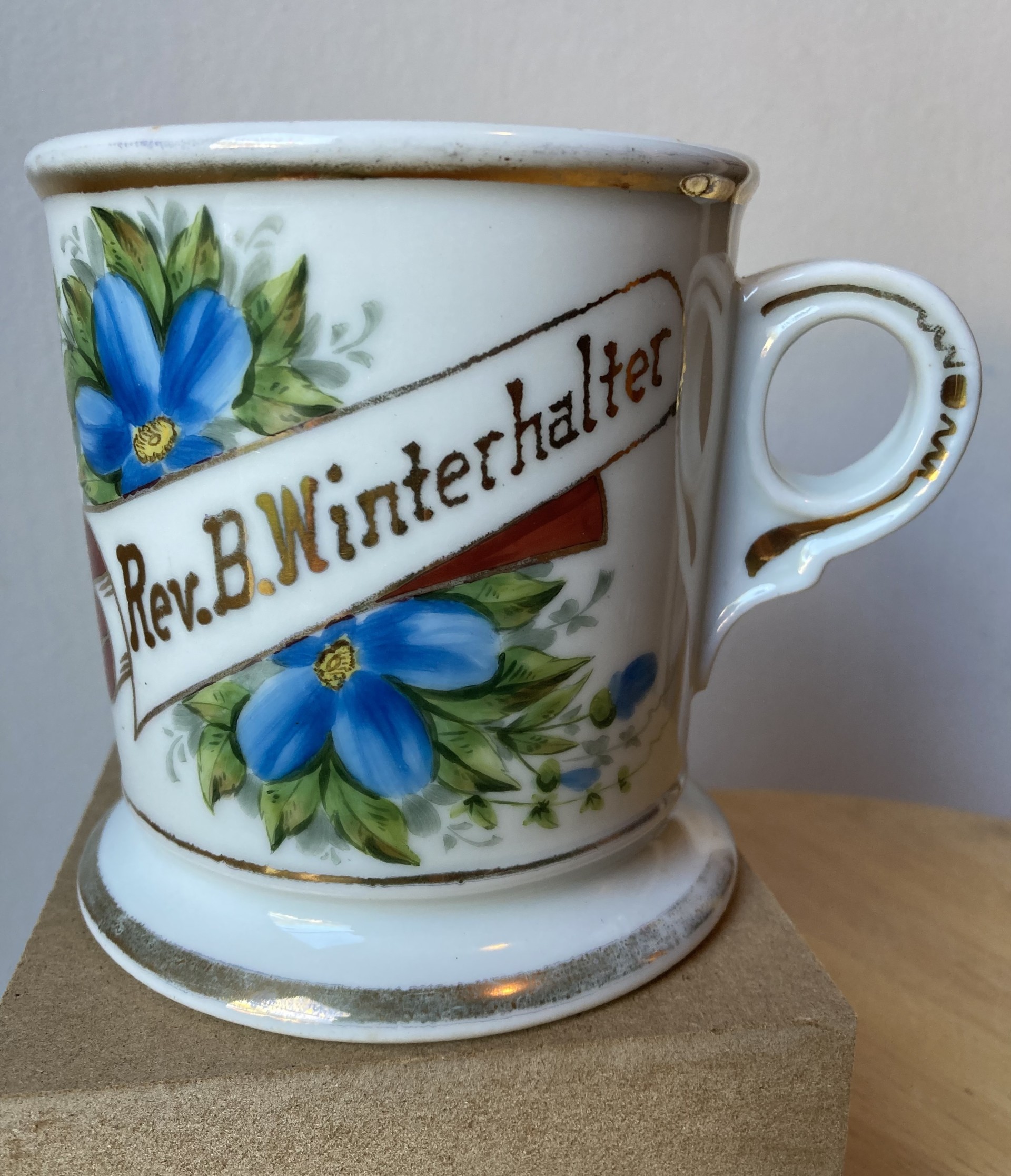 In an 1891 biographical sketch, part of the “ILGenWeb” project of Calhoun County, Illinois, Reverend Winterhalter at St. Mary’s church “has now under his charge one of the most flourishing churches in the diocese. He has infused new life into the society, which has grown greatly under his administration, and now includes 80 families. . . . Under his pastorate, new buildings have been erected including the church, which is a handsome brick structure, 40 x 85 feet in dimensions, . . . a neat and commodious parsonage also of brick, and a substantial school building, which . . . has an attendance of from 75 to 80 pupils.”
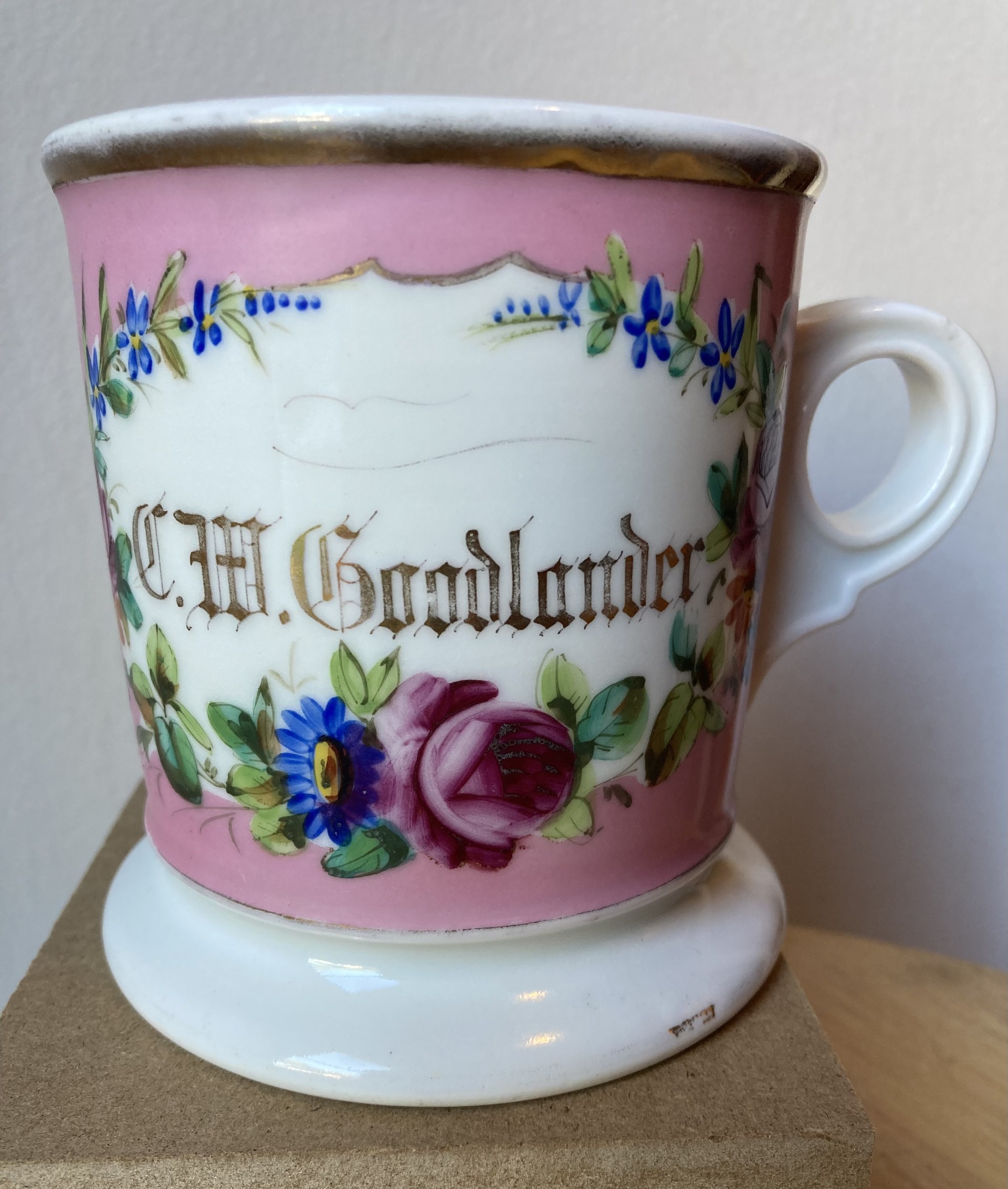 As his entry in Wikipedia notes, Charles Wesley “C. W.” Goodlander (1834-1902) was an American builder, banker, businessman, hotelier, and author. He was also an architect, and he designed the Cherokee National Capitol building in Tahlequah, Oklahoma(1869). He also designed the Goodlander Hotel (1887), a city hall, and a Presbyterian church in Fort Scott, Kansas.
This shaving mug could have belonged to Goodlander’s nephew, also named Charles Goodlander (1863-1914), who served as mayor of Fort Scott.
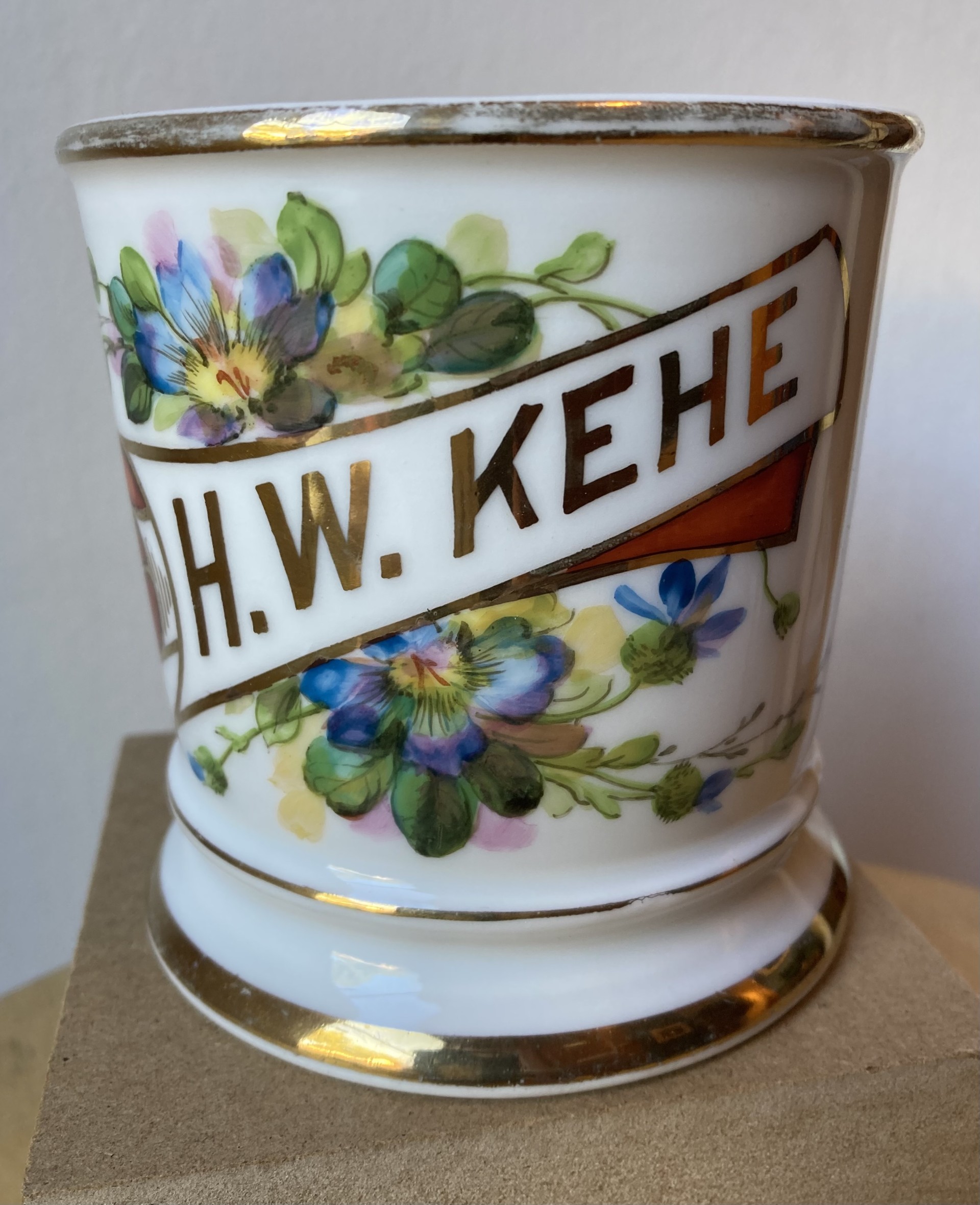 A man named Henry W. Kehe was born in Bremer County, Iowa, in 1887. As noted in an article in the February 15, 1955, issue of the Waterloo Daily Courier, “Mr. Kehe and the former Sophia Schumacher were married on February 11, 1915, in St. Peter Luther Church. They farmed near Klinger, later moved to Klinger, and last year moved to Denver.” (Klinger and Denver are communities in Bremer County.) Retired farmer Kehe died in 1960 in Waterloo, Iowa, and was buried in Bremer County. Henry W. Kehe’s obituary is in the Daily Courier of June 16, 1960. See also his entry in the website FindaGrave.com.
Some shaving mugs were dated with individual years, which usually represented significant personal or organizational milestones in a man’s life. The occasion could have been a coming-of-age celebration, birthday, marriage, or initiation into a fraternal order. Because floral “blanks” (blank porcelain mugs adorned with stock, generic flower designs, such as some of the ones on this page) were much less expensive than hiring a professional artist to paint custom occupation scenes, they were the standard choice for family gifts.
For instance, a young man turning 18 or 21 was often given a shaving mug to honor his entry into adulthood and the beginning of a lifetime of daily shaving. When a man was initiated into a local fraternal lodge, he was frequently given or commissioned a personalized mug to keep on the lodge’s razor rack or at his local barbershop. The shaving mug featured below may have belonged to Archie W. Maslin (1906-1984) of Philadelphia, Pennsylvania, and Vineland, New Jersey, to represent a job promotion.
According to Maslin’s obituary in the June 24, 1984, issue of the Philadelphia Inquirer, Archie W. Maslin was a former president of Local 234 of the Transport Workers Union of Philadelphia. “Mr. Maslin was a native of Townsend, Delaware, but moved to Philadelphia to look for work in 1920. He found a job as a salesman for the Singer Sewing Machine Company, and in three years was promoted to regional sales manager and transferred to the company’s offices in York, Pennsylvania.” This shaving mug dated 1923, therefore, could have represented his promotion and transfer.
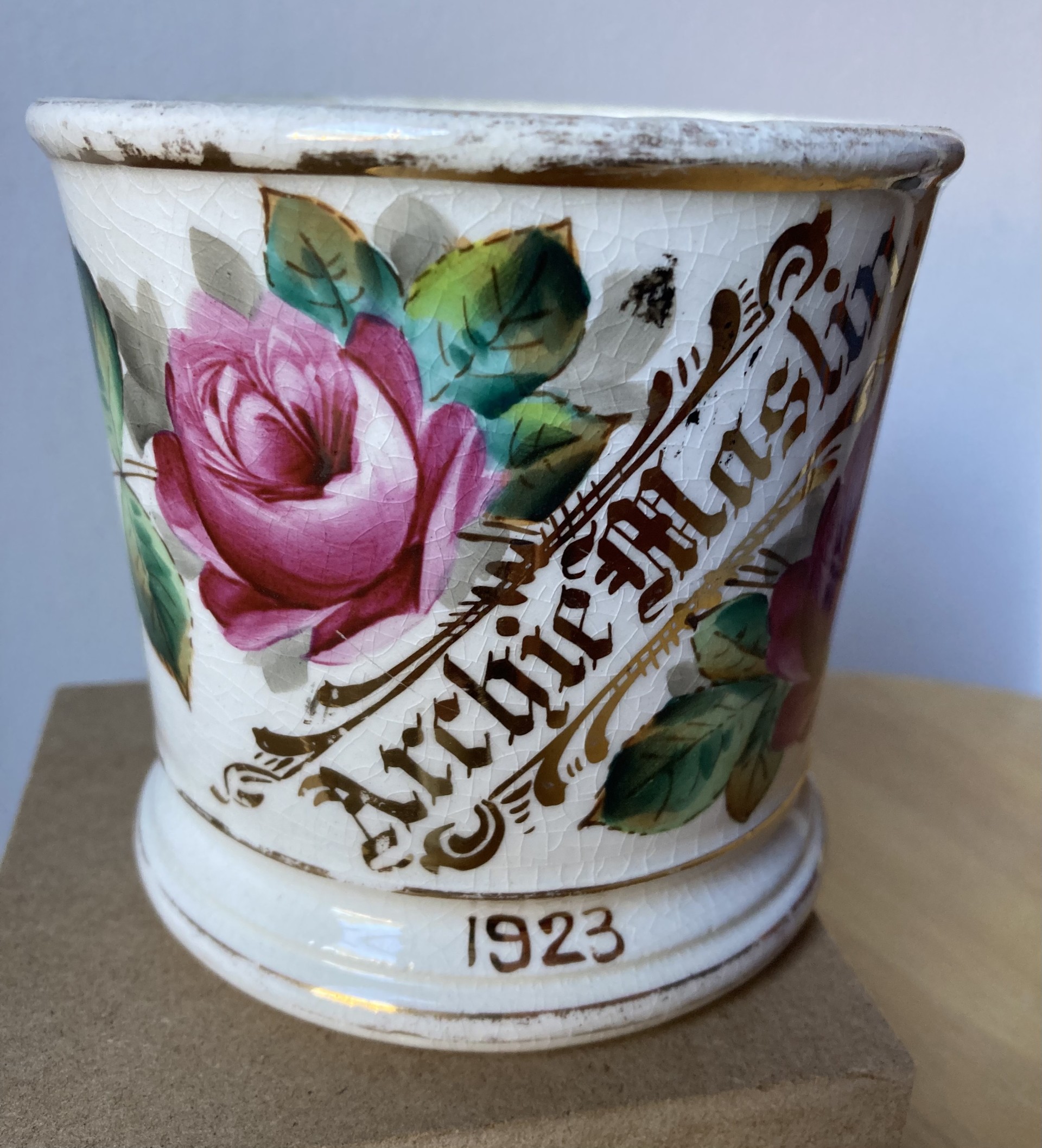 “W.B.S. Co.” is carefully printed by hand in gold on the bottom of Maslin’s mug. This firm was a notable American barber supply distributor active in the late nineteenth and early twentieth centuries. Rather than creating porcelain products themselves, they sourced “blank” white ceramic and ironstone mugs from various potteries (such as Anchor Pottery in Trenton, New Jersey) and imported blank mugs from European manufacturers in Germany, France, and England. They then personalized the mugs for local barbershops and retail customers. (I mention this common practice in the first paragraph above.)
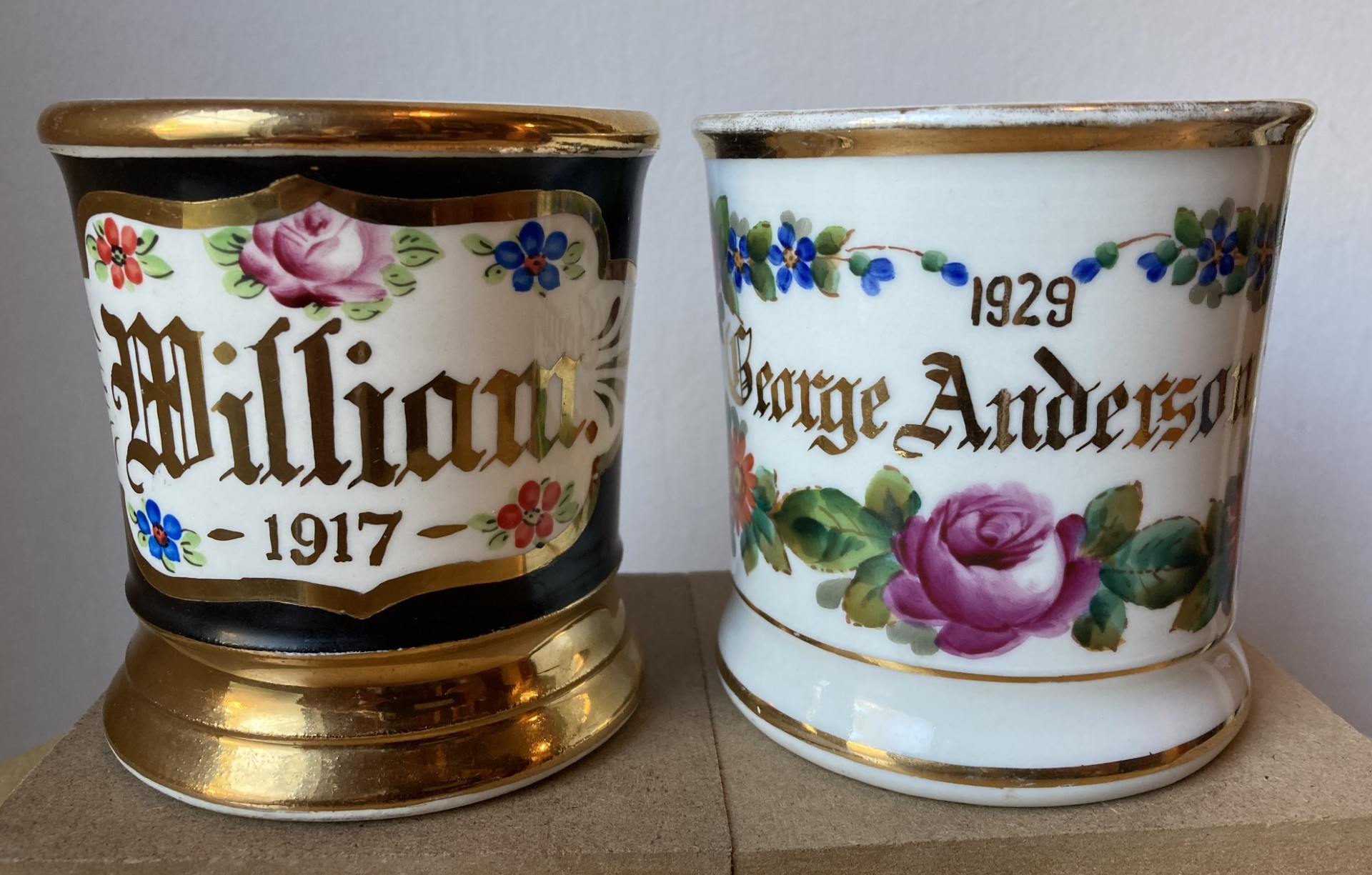 In 1917, William’s friends may have helped him celebrate a significant event in his life by presenting him with his own shaving mug. George Anderson was similarly honored in 1929. During the heyday of shaving mugs, men often received personalized mugs to commemorate milestones in their lives. (Click on image to enlarge.)
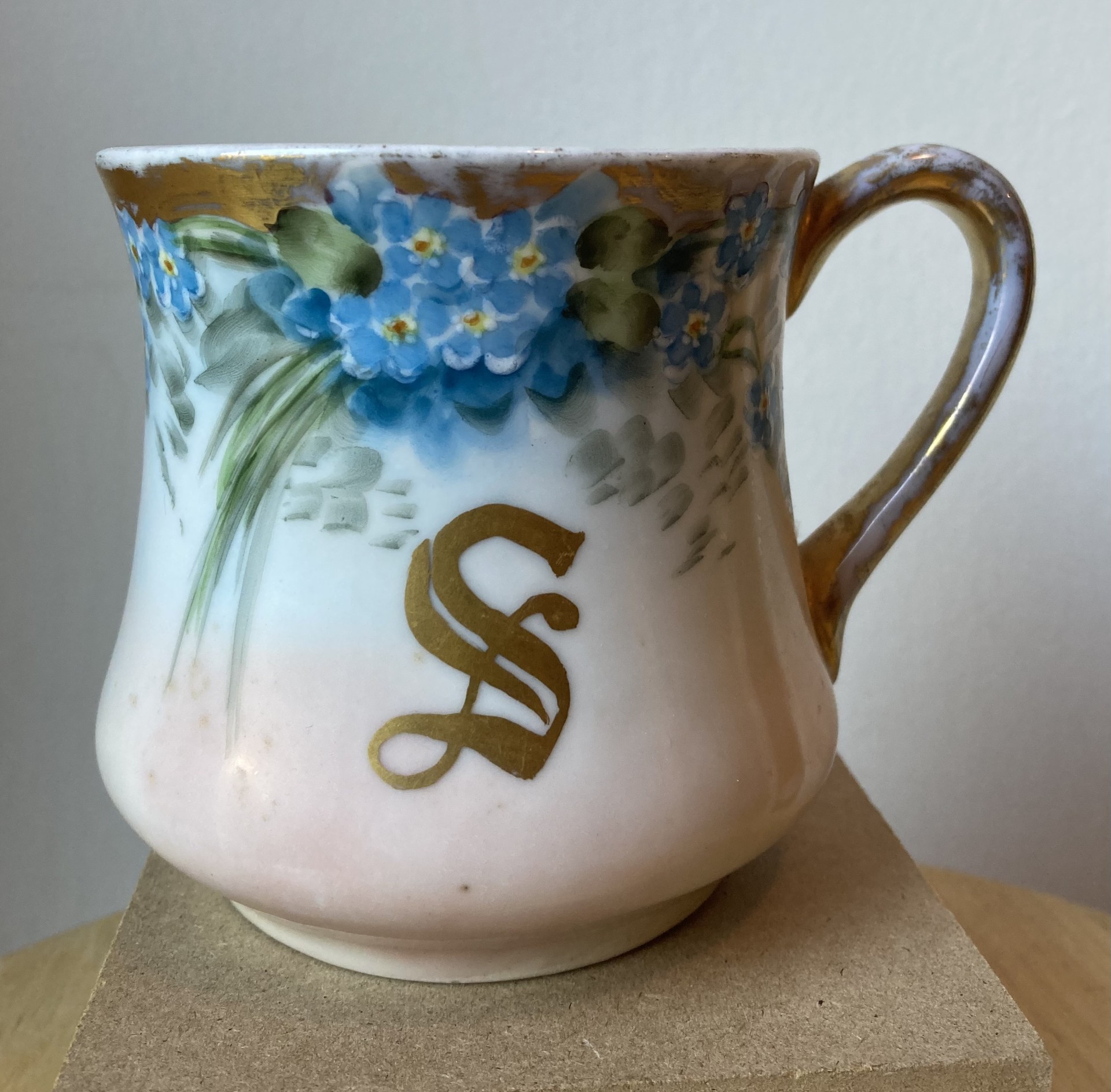 The maker’s mark of “Burton” on the bottom of this beautiful shaving mug with its gold capital letter “S” represents William Burton of the well-known Pilkington’s Tile and Pottery Works of Manchester, England. As the Pilkington’s Lancastrian Pottery Society maintains, Burton’s career in pottery “transformed him into one of the most influential figures in ceramic art and science.” He became “the ‘sole master’ at Pilkington’s Tile and Pottery Works,” and his “life was a blend of scientific rigour, artistic vision, and humanitarian concern.”
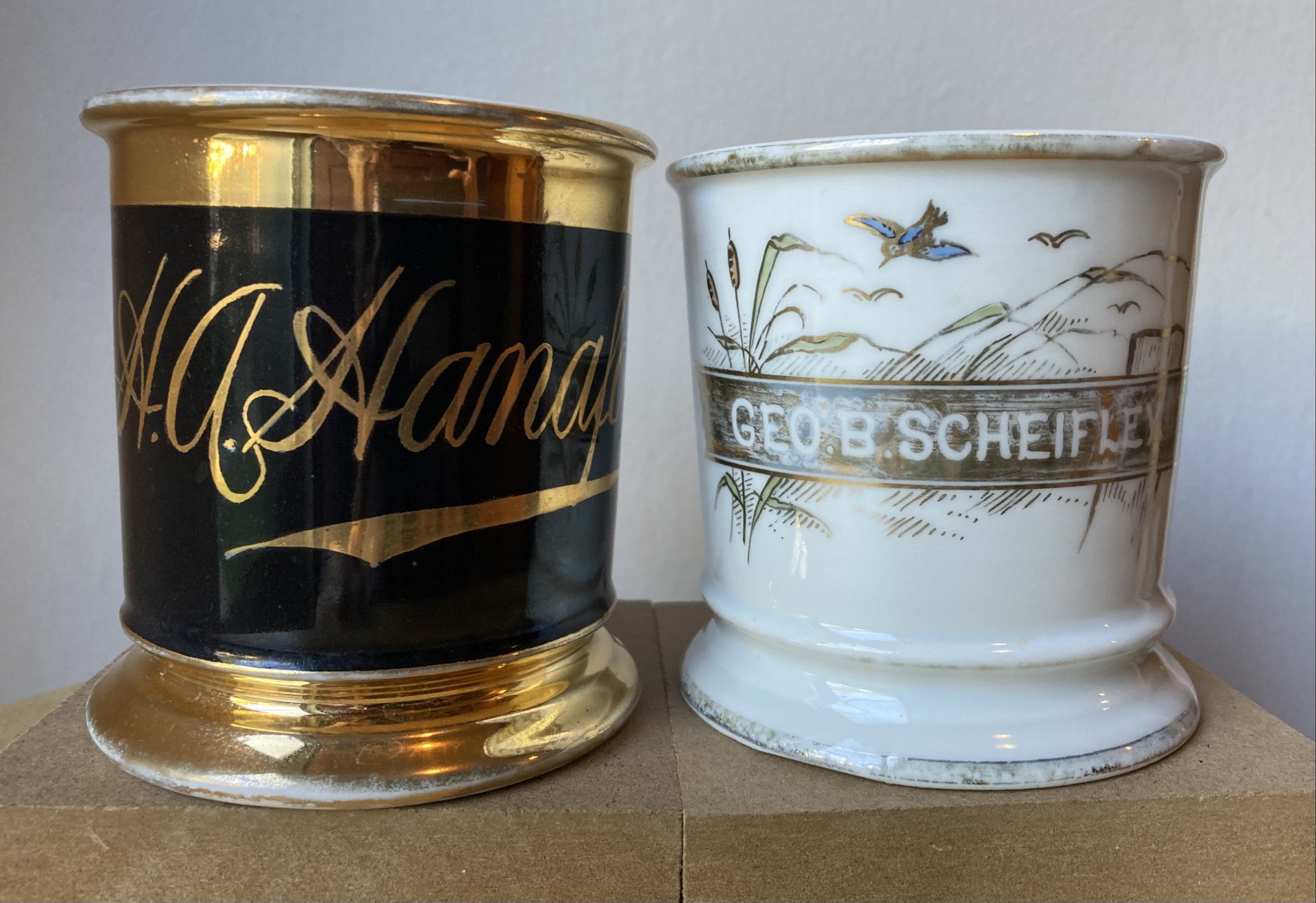 This black and gold mug bears the name of “H. A. Hanaford, M.D.” The obituary of one Dr. Howard A. Hanaford (1875-1931) in the March 4, 1931, issue of the Telegraph-Journal of Saint John, New Brunswick, Canada, relates that he was for years “an outstanding physician and surgeon” of New Hampshire. George B. Scheifley of Minnesota was born in 1913 and died in 1996. (Click on image to enlarge.)
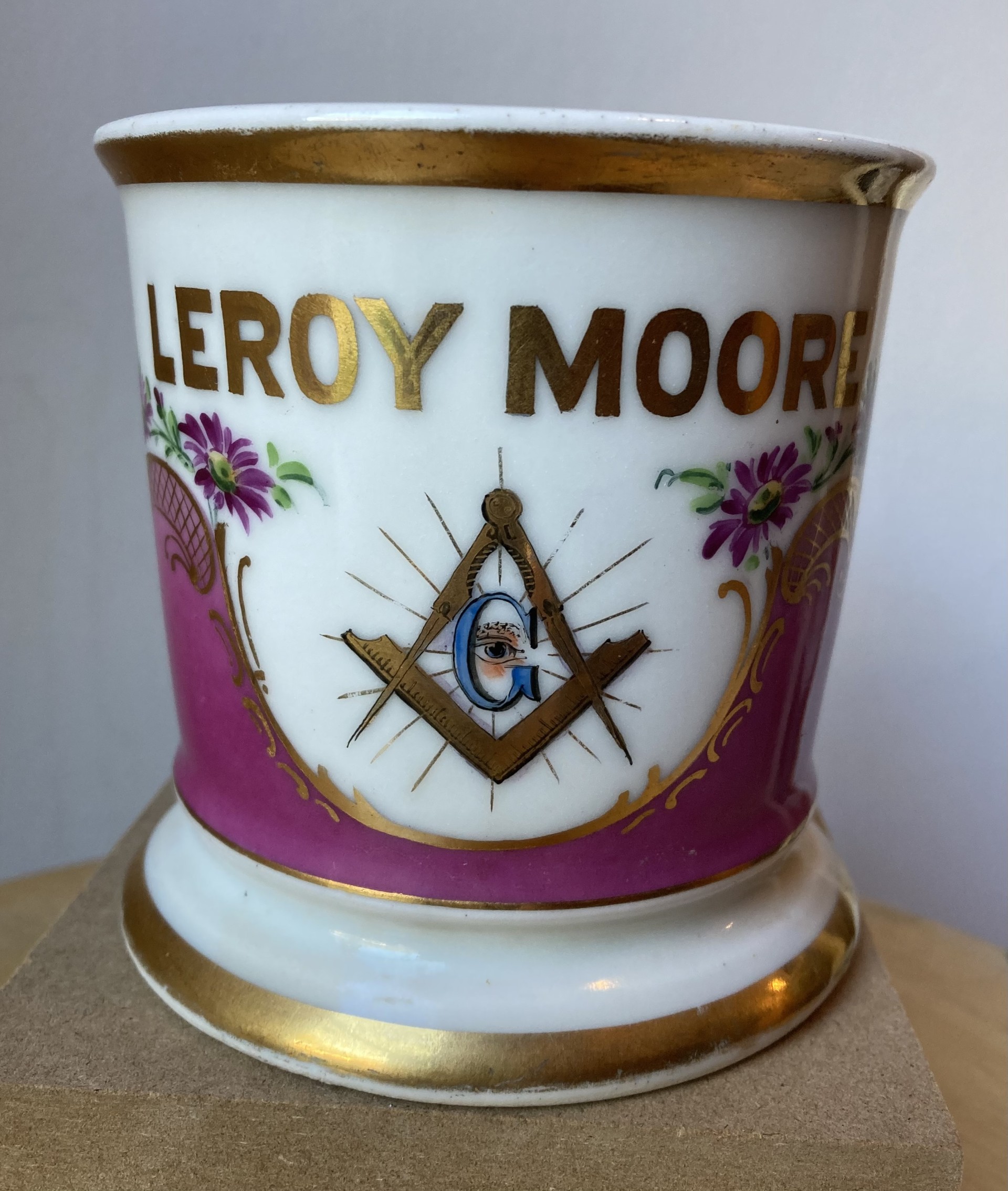 Fraternal shaving mugs feature the symbols of lodges, secret societies, or service organizations (such as the Freemasons or Knights of Pythias). Leroy Moore belonged to the Freemasons, and the Masonic emblem combines several tools to create something of a blueprint for living a good, balanced life. The Compass represents boundaries and self-control. The Square represents honest and fairness. The letter “G” stands for Geometry and God. The Eye of Providence represents watchfulness and accountability. (See, for example, “Behind the Masonic Symbols,” with one part discussing the Square and Compasses, and another the Eye of Providence.)
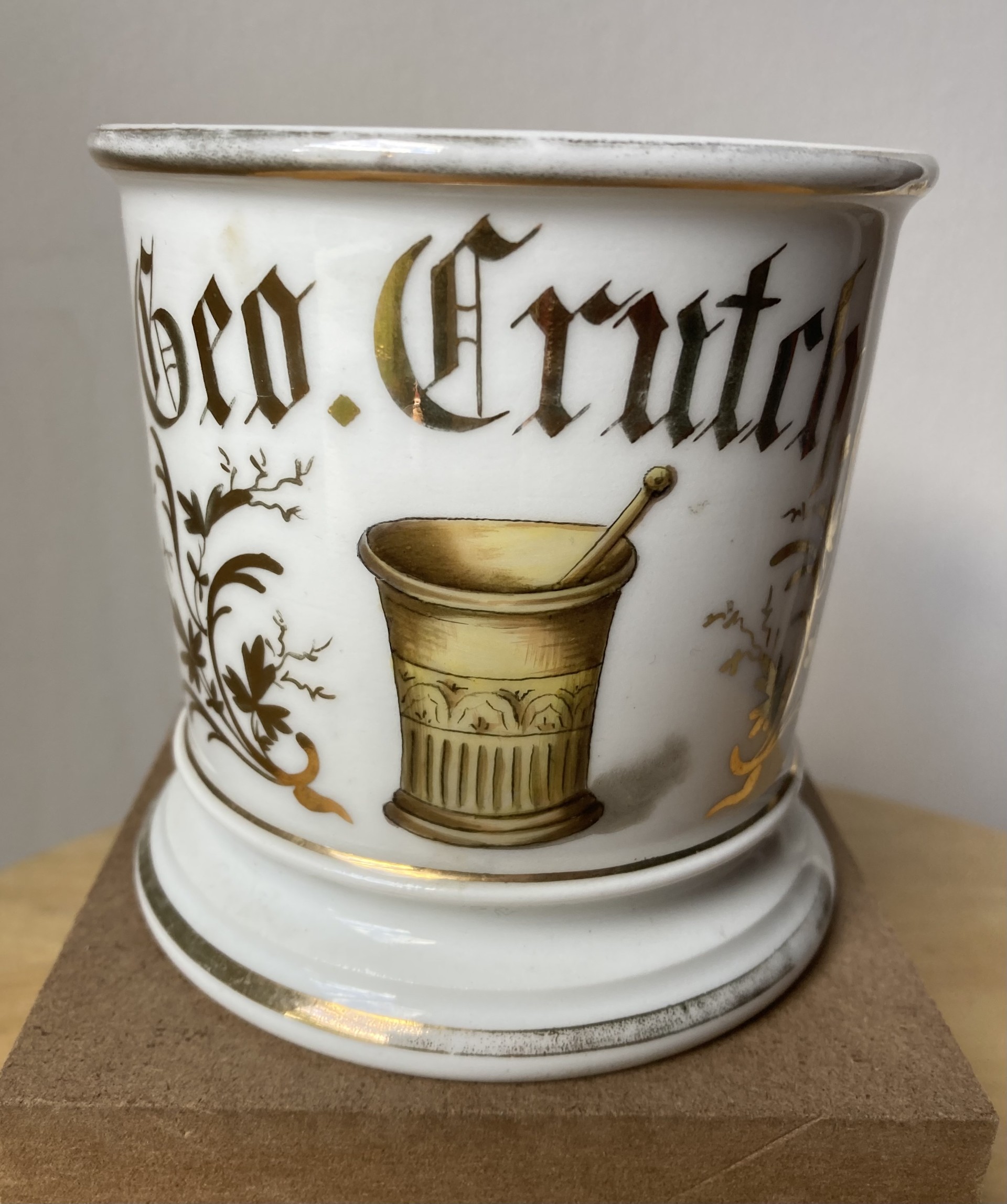 Occupational shaving mugs feature hand-painted depictions of the owners’ professions. Some 600 occupations—such as butchers, carpenters, bank cashiers, firefighters, undertakers, railroad workers–and yes, barbers–are represented in mug collections, and the rarity of the trade increases the mugs’ collectibility. Burt Handelsman writes that “lawyers, doctors and other professional men were less inclined to advertise themselves, even within the clubhouse atmosphere of the barbershop, than were the more gregarious merchants and tradesmen of the neighborhood. A professional man’s shaving mug, therefore, is less likely to surface and is worth more when it does.”
The mortar and pestle is a traditional symbol of pharmacy and the apothecary profession, which makes the mug above an excellent example of an occupational shaving mug. George R. Crutch (1878–1957) was a prominent citizen and local public official in Litchfield, Connecticut. His family drug business, Crutch’s Pharmacy (later known as Crutch & Marley, and eventually Crutch & MacDonald), was a prominent community landmark for nearly a century.
The drugstore was originally opened as Wessells & Gates in 1888. George’s father, Aaron Crutch, took it over in 1899 and renamed it Crutch’s Pharmacy. Aaron and his other son, William Crutch, operated the business as practicing druggists, and it remained open until 1994.
As for George R. Crutch, he owned and operated the Litchfield Ice Company and had an office in the pharmacy before he built the Crutch Frozen Food Locker Company. His father had originally purchased the ice harvesting business in 1879 before moving into the pharmacy trade. George’s obituary states that “he had been engaged in the plumbing business until 1919. He conducted an ice business from that time until 1940.”
George was highly involved in local Connecticut politics. He served as both a burgess and a warden for the borough of Litchfield throughout the late 1940s and early 1950s and ran as a Democratic candidate for State Representative in 1934. (See “George R. Crutch Dies,” Hartford Courant, January 22, 1957, and “W. A. Crutch Dies at 71; Ex-Druggist,” Hartford Courant, August 26, 1947. See also Erica Blank’s “The Forgotten Charm of the Barbershop Occupation Mugs,” a posting on the website Messy Nessy’s Cabinet.)
Occupational shaving mugs stand out as both valuable and sought-after collectibles. They function as rare, hand-painted pieces of Americana that document late 19th- and early 20th-century history, personal status, and the various trades of that era. For these reasons they often command premium prices, and I consider myself fortunate to have purchased the Crutch pharmacy mug at a reasonable price. Not only is it attractive, but the Crutch family’s pharmacy–which bore their name–was a well-known and respected drug store in the Litchfield, Connecticut area. Historical records, account books, and vintage photographs of the pharmacy are preserved today by the Litchfield Historical Society.
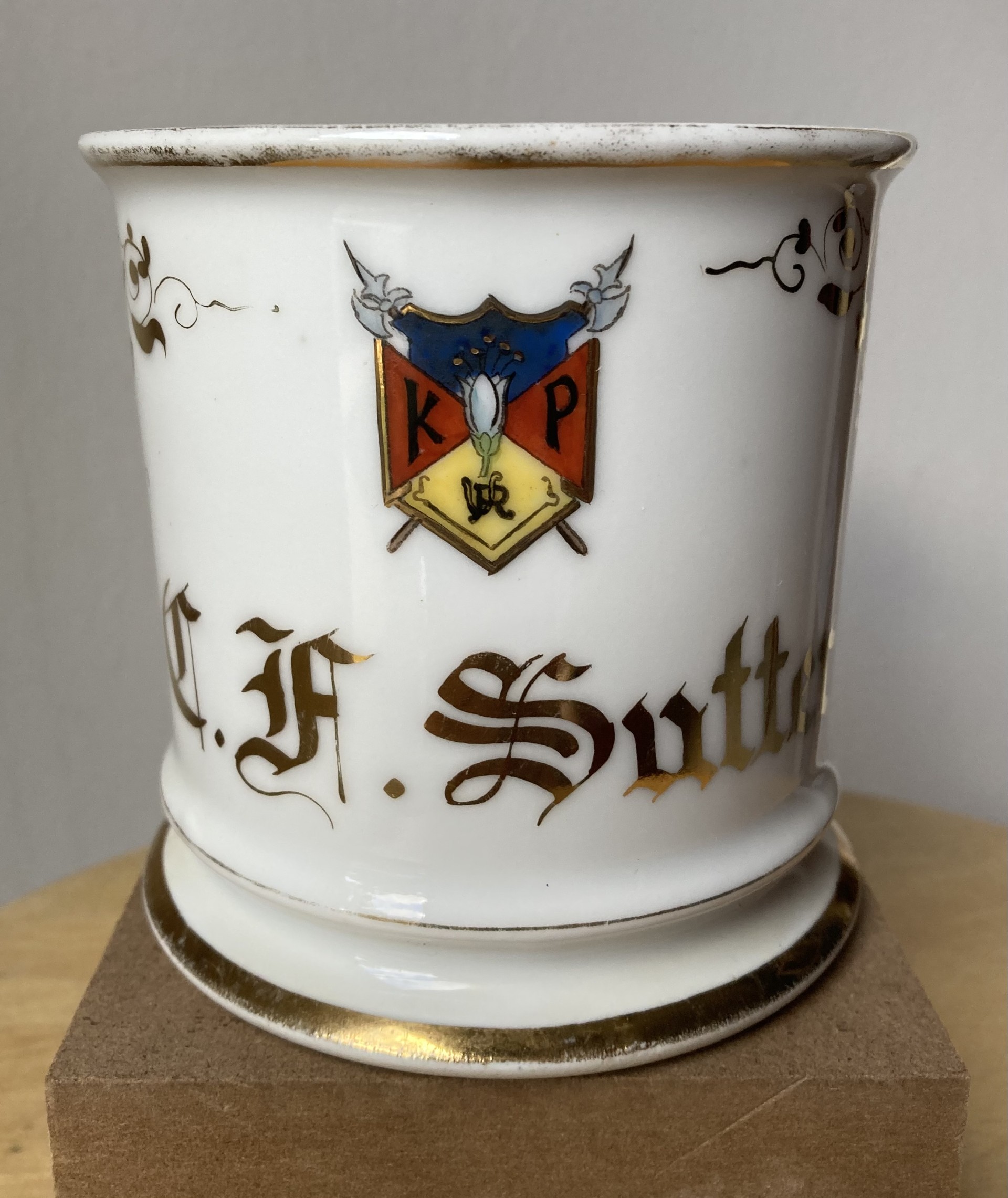 The mug at left, which belonged to Charles F. Sutter (1878-1930), joins the Leroy Moore mug above as an example of a fraternal shaving mug. Sutter was an undertaker in Carey, Ohio, and his mug features the emblem of the Knights of Pythias. The organization’s motto is “Friendship, Charity, and Benevolence” and is represented by the colors blue, red, and yellow. Sutter’s obituary, “C. F. Sutter Dies Suddenly,” in the September 10, 1930, issue of the Marion (Ohio) Star, notes that “he was a member of the Lutheran church, Findlay [Ohio] lodge of Elks, Moose, Knights of Pythias and Odd Fellows of Carey.”
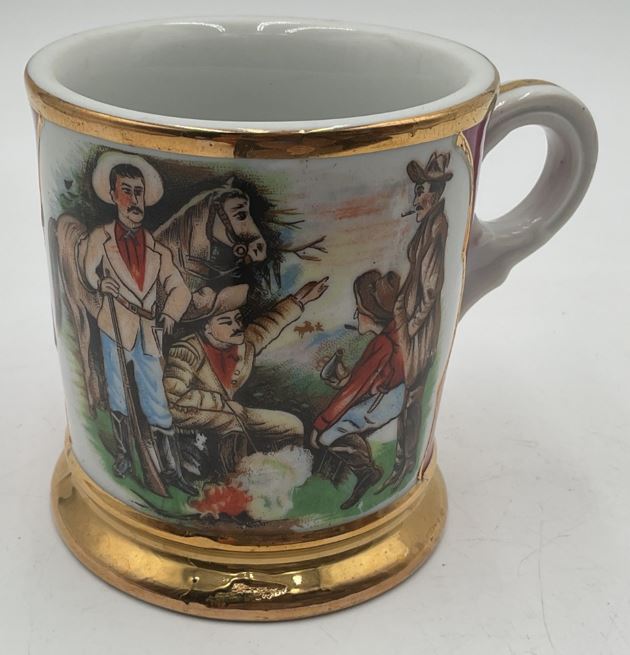 Occasionally a painted scene fills up the entire front of a shaving mug, as this “cowboy” design illustrates. The absence of a name allows for the unusually detailed and graphic illustration. In fact, I think a fine collection could be devoted to just this type of colorful mug. (One should read sellers’ descriptions carefully, however. I’ve seen mugs adorned with flowers described as florists’ occupational mugs, though actually they were simply “blanks” painted with generic flower designs. This is described in the paragraph after the H. W. Keehee mug, above.)
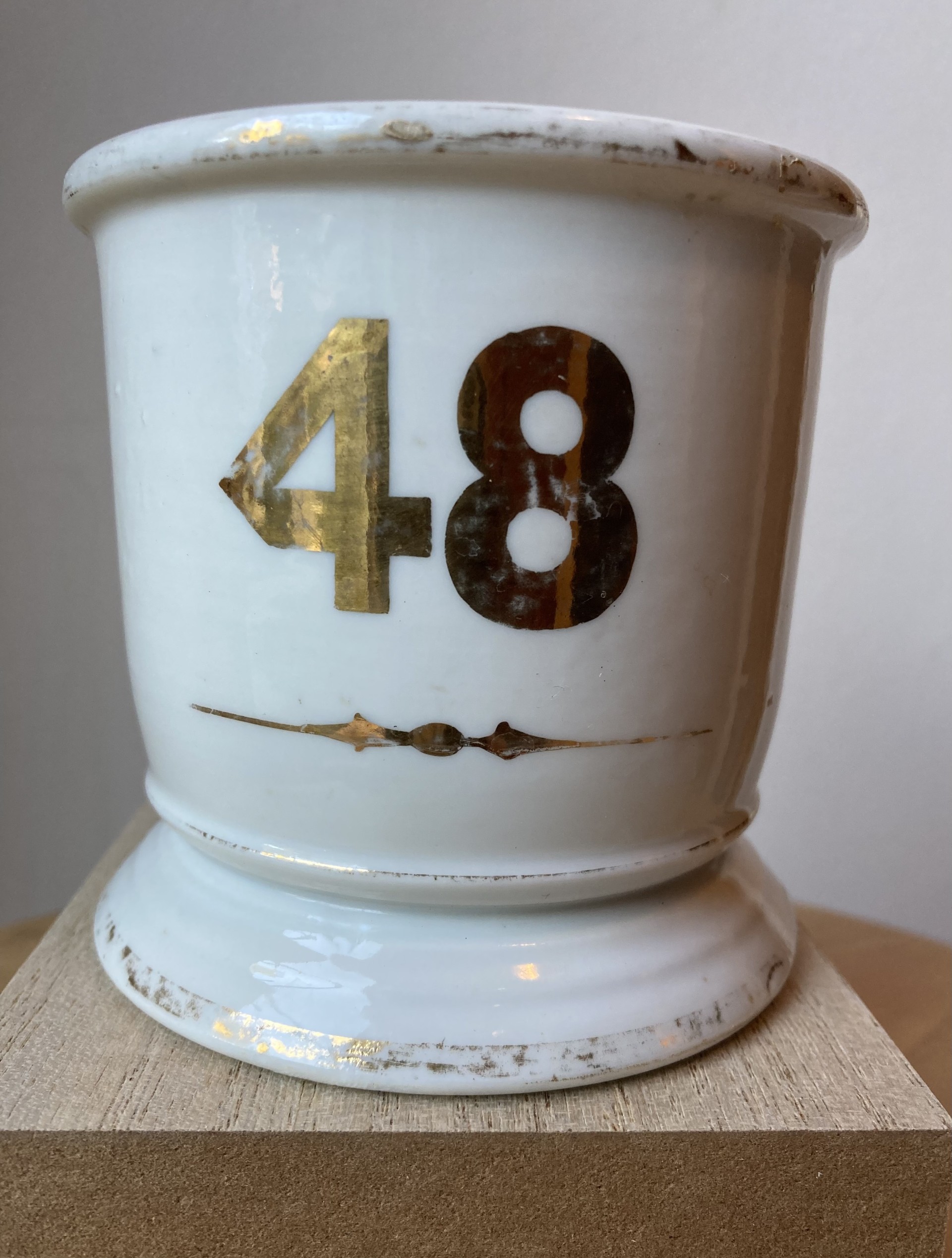 Why is there a number on this shaving mug rather than a name, initial or a painting of some sort? Burt Handelsman explains in his “Shaving Mugs” essay that numbered mugs “were kept in hotel barbershops, and were reserved for the use of guests occupying the corresponding room.”
Also, barbershops stored numerous–sometimes hundreds–of personal, hand-painted mugs on wall-mounted racks. In some shops, customers were identified by a straightforward numbering system linked to their designated slots or ledger numbers, instead of displaying their full names or occupations on personalized mugs.
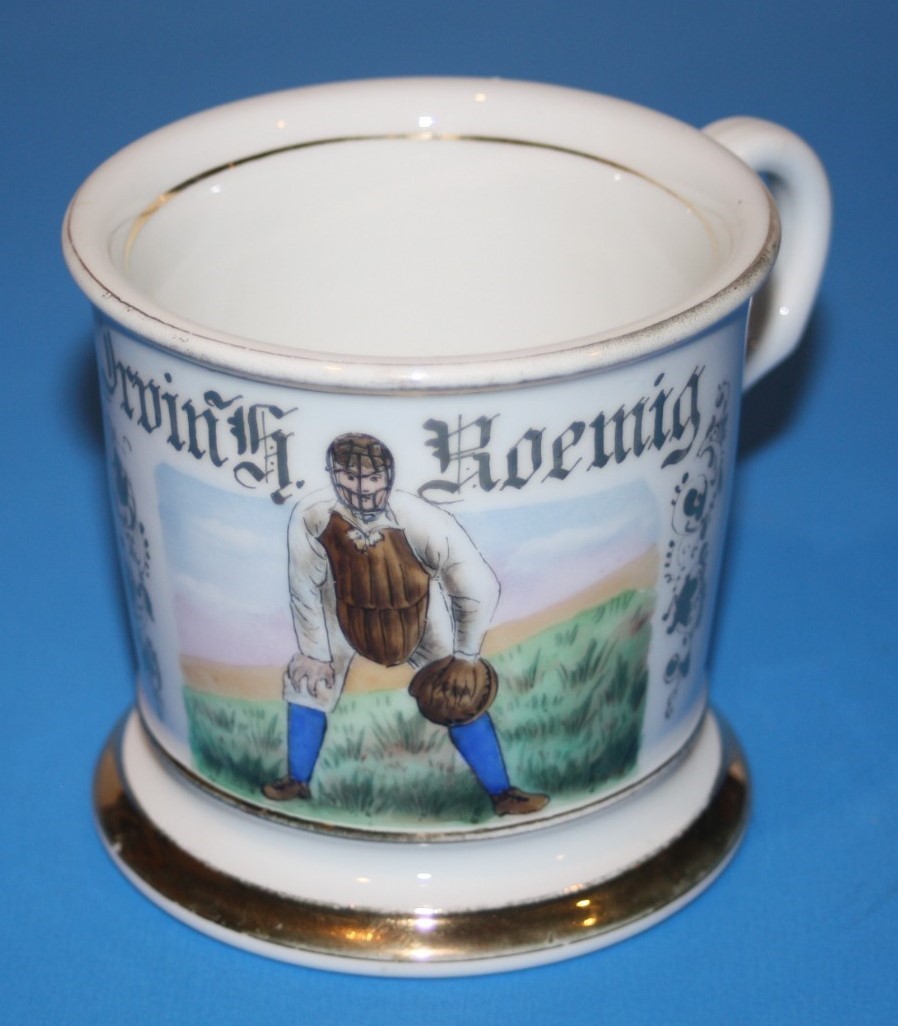
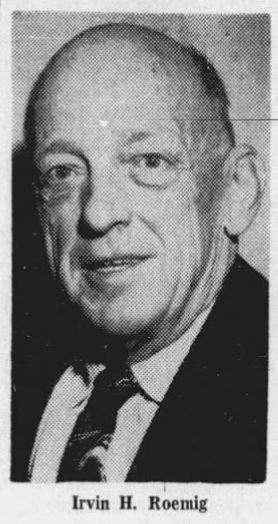 This shaving mug reflects the baseball and sports interests of its owner. According to the Lebanon (Pennsylvania) Daily News of March 8, 1957, the “popular” Irwin H. Roemig of Annville, Pennsylvania “is active in many civic organizations and has been extremely active in community affairs since his retirement from business several years ago. . . . He is a former president of the Lebanon County Baseball League and former head of the Annville Athletic Association.” Roemig died in 1972. (Click on images to enlarge.)